Tutorial for NIRCam Coronagraphy Reduction with spaceKLIP
In this notebook, you will learn how to reduce NIRCam coronagraphy data from the JWST ERS program on Direct Observations of Exoplanetary Systems (Program 1386), with a focus on the exoplanet HIP 65426 b. The tutorial guides you step-by-step through the data reduction process using the spaceKLIP pipeline, offering a clear and concise workflow tailored for effective high-contrast imaging analysis. By the end of this
notebook, you will have gained hands-on experience with the tools and techniques necessary for reducing NIRCam coronagraphic data, preparing you to apply these methods to other similar datasets.
Related Tutorials and Further Information: This notebook is intentionally very similar to the “Tutorial for MIRI Coronagraphy Reduction with spaceKLIP” notebook. Subsequent analyses will be done in the “Tutorial for NIRCam Post-Pipeline Contrast Analyses Using spaceKLIP” notebook. For complete interactive plotting capabilities, download the notebook and execute it locally.
NIRCam-specific Information: Steps and information specific to NIRCam are called out in blue.
Table of Contents
Introduction
Directly imaging a planet or circumstellar disk around another star is a challenging task that requires specialized techniques and systems to suppress the star’s bright light while preserving the faint light from the planet or disk, which otherwise would be obscured by the star’s glare. This is achieved using starlight suppression optical systems, such as a starshade occulter or coronagraph, active wavefront control, advanced image processing techniques like differential imaging, and post-processing algorithms that effectively remove residual starlight (also referred to as speckles) using point spread function (PSF) subtraction methods. These advanced astronomical technologies and techniques enable High-Contrast Imaging (HCI), making it possible to study and characterize planetary systems in unprecedented detail.
A coronagraph instrument is a fundamental technology used for HCI as it is designed to block the light of an on-axis source, such as a star’s light, using an internal or external occulter while letting the light of off-axis sources, like planets, to continue to pass through the optical system to the detector. The most common type of coronagraph is a Lyot-coronagraph which the Near Infrared Camera (NIRCam) on the James Webb Space Telescope (JWST) exemplifies, featuring five Lyot-type coronagraphs that facilitate HCI at wavelengths of 2–5 µm with sub-arcsecond inner working angles (IWA) that allow for imaging of objects very close to their host. However, coronagraphs have certain limitations.
While coronagraphs block most of the star’s light, there is some star leakage (or diffracted starlight) that propagates to the detector and results in a residual starlight “speckle” pattern or static wavefront errors that require additional post-processing and imaging techniques to remove. Also, the coronagraph design places constraints on the field of view (i.e., IWA), bandpass limitations, etc.
To address the limitations of coronagraphy, differential imaging techniques are used to separate starlight from the faint signals of celestial companions by exploiting differences in target, wavelength, or angular position. We use the following later in the notebook:
Angular Differential Imaging (ADI): This technique relies on the rotation of the telescope to capture a series of images at different field orientations. By aligning and combining these images, ADI can effectively differentiate the relatively static starlight from the rotating signal of the faint companion, enhancing contrast and detectability.
Reference Differential Imaging (RDI): This technique uses reference images of similar stars taken under similar observing conditions to subtract starlight from the target star’s images.
Spectral Differential Imaging (SDI): This technique takes advantage of the wavelength-dependent differences in the light from a star and its companion. Comparing images taken at different wavelengths helps suppress starlight while preserving the signal from the companion.
Post-processing algorithms such as Karhunen-Loève Image Processing (KLIP) are used to perform PSF Subtraction and can enhance differential imaging techniques like ADI, RDI, and SDI. KLIP uses Principal Component Analysis (PCA) to create a model of the residual starlight PSF tailored to the observed data. Subtracting this model from the images helps remove the leftover residual light while preserving the light from faint sources. The spaceKLIP data reduction pipeline simplifies and streamlines the reduction and application of KLIP on JWST high-contrast imaging data.
ADDITIONAL RESOURCES
HCI Overview: A comprehensive introduction to High-Contrast Imaging.
PCA Example: A clear example to visualize Principal Component Analysis.
Setup and Imports
[1]:
# Generate interactive plots?
interactive = True
try:
import plotly.io as pio
pio.renderers.default = "sphinx_gallery"
except ImportError:
interactive = False
print("Plotly is not installed. "
"Falling back to static Matplotlib plots.")
[2]:
import os
import numpy as np
import subprocess
import spaceKLIP
import matplotlib
matplotlib.rcParams.update({'font.size': 14})
%matplotlib inline
from astropy.io import fits
Note that currently the import of webbpsf_ext has a side effect of configuring extra verbose logging. We’re not interested in that logging text, so let’s quiet it.
[3]:
import webbpsf_ext
webbpsf_ext.setup_logging('WARN', verbose=False)
Precursor: Download the Data
If you already have a copy of this data, you can adjust the paths below accordingly. In this notebook, we assume you don’t have the data yet, so let’s download it here.
We will use/install the latest development version of the jwst_mast_query package for this. Consult the package’s documentation for more details.
We’ll download all the uncalibrated raw data (uncal.fits), as we will use spaceKLIP to invoke the JWST pipeline with customized options and extra steps optimized for coronagraphy.
[4]:
# Name the root directory where we will keep the data for this tutorial.
data_root = 'data_nircam_hd65426'
[5]:
# Make subdirectories to put the data in.
os.makedirs(data_root, exist_ok=True)
os.makedirs(os.path.join(data_root, 'uncal'), exist_ok=True)
# Invoke the download.
download_cmd = (
"yes | jwst_download.py --propID 1386 -i nircam -l 700 --obsnums 1 2 3 "
"--outsubdir data_nircam_hd65426/uncal --skip_propID2outsubdir "
"-f uncal --date_select 59789.0+"
)
process=subprocess.Popen(download_cmd, shell=True,
stdout=subprocess.PIPE,
stderr=subprocess.PIPE)
stdout, stderr = process.communicate()
# Uncomment to print the download log and any errors.
# print(stdout.decode())
# print(stderr.decode())
Stage 1 Reductions
Index Files into Database for Stage 1
SpaceKLIP relies on a Database class to track observations, data files, and the relationships between them.
We begin by creating a database and reading files into it.
For this tutorial, let’s only reduce one filter’s worth of data.
[6]:
program = 1386 # Define the program.
filt = 'F444W' # Set to None to disable filter selection and load all filters.
[7]:
# Initialize spaceKLIP database.
database = spaceKLIP.database.create_database(
input_dir=os.path.join(data_root, 'uncal'),
output_dir=data_root,
filt=filt,
pid=program)
2026-06-03 13:12:17,481 - CRDS - INFO - Calibration SW Found: jwst 2.0.1 (/opt/anaconda3/envs/spaceklip_may26/lib/python3.11/site-packages/jwst-2.0.1.dist-info)
[spaceKLIP.database:INFO] --> Identified 1 concatenation(s)
[spaceKLIP.database:INFO] --> Concatenation 1: JWST_NIRCAM_NRCALONG_F444W_MASKRND_MASK335R_SUB320A335R
TYPE EXP_TYPE DATAMODL TELESCOP ... ROLL_REF BLURFWHM NANMASKFILE
---- --------- -------- -------- ... ------------------ -------- -----------
SCI NRC_CORON STAGE0 JWST ... 110.30193021095504 nan NONE
SCI NRC_CORON STAGE0 JWST ... 120.38229928196697 nan NONE
REF NRC_CORON STAGE0 JWST ... 110.03164122132496 nan NONE
REF NRC_CORON STAGE0 JWST ... 110.03167106048886 nan NONE
REF NRC_CORON STAGE0 JWST ... 110.03169329703867 nan NONE
REF NRC_CORON STAGE0 JWST ... 110.03168369754667 nan NONE
REF NRC_CORON STAGE0 JWST ... 110.03167513985059 nan NONE
REF NRC_CORON STAGE0 JWST ... 110.03166494498083 nan NONE
REF NRC_CORON STAGE0 JWST ... 110.03164410548654 nan NONE
REF NRC_CORON STAGE0 JWST ... 110.03167094090834 nan NONE
REF NRC_CORON STAGE0 JWST ... 110.03168049531574 nan NONE
The above is a bit verbose and can be difficult for a human to parse; let’s ask the database to summarize what it contains:
[8]:
database.summarize()
NIRCAM_F444W_MASK335R
STAGE0: 11 files; 2 SCI, 9 REF
Above, you should notice two types of files contained in the database:
Science (
SCI): These files hold the primary coronagraphic observational data of the target—in this case, the exoplanet host star HIP 65426. This program also conducted coronagraphic observations at two separate roll angles, which refer to specific pointing/orientation of the telescope. Hence, there are twoSCIfiles.Reference
REF: These files contain the reference PSF observations of other stars—in this case, of the nearby star HIP 68245. There are nineREFfiles, one for each dithered exposure.
Run Stage 1 Pipeline
The Coron1Pipeline (calwebb_coron1↘️) in spaceKLIP is a custom subclass of the JWST Stage 1 pipeline, Detector1Pipeline (calwebb_detector1↘️). It is specifically designed to optimize the processing of high-contrast imaging data typical of coronagraphic observations. This pipeline applies group-by-group
detector-level corrections, followed by ramp fitting, to the raw, uncalibrated data (uncal.fits↘️). The output is calibrated count rate products
(rateints.fits↘️).
The Coron1Pipeline performs the following steps for NIRCam. Custom spaceKLIP steps and parameters are marked with stars (⭐). Click on the steps with the attached (ReadtheDocs 📄) links to learn more about specific JWST pipeline steps.
group_scale(ReadtheDocs 📄)
dq_init(ReadtheDocs 📄)
saturation(ReadtheDocs 📄)
flag_rcsat: Flag high dark current RC pixels as saturated? (Default: False).
grow_diagonal: Flag diagonal neighboring pixels (or only bottom/top/left/right)? (Default: True).
n_pix_grow_sat(ReadtheDocs 📄)
ipc(ReadtheDocs 📄)
superbias(ReadtheDocs 📄)
refpix(ReadtheDocs 📄)
odd_even_columns(ReadtheDocs 📄)⭐
nlower,nupper,nleft,nright: Number of pixels around edges to use as pseudo-refpix in NIRCam subarrays (Default: 4).⭐
nrow_off,ncol_off: Offset the reference pixel region from the top/bottom and left/right edges of the frame (Default: 0).
linearity(ReadtheDocs 📄)
dark_current(ReadtheDocs 📄)
persistence(ReadtheDocs 📄)
jump(ReadtheDocs 📄)
rejection_threshold(ReadtheDocs 📄) ,three_group_rejection_threshold(ReadtheDocs 📄),
four_group_rejection_threshold(ReadtheDocs 📄) ,maximum_cores(ReadtheDocs📄)⭐
subtract_1overf: Removes 1/f noise from the data.
⭐
model_type: Type of model to fit for 1/f noise removal (‘median’, ‘mean’, Defualt: ‘savgol’)⭐
sat_frac: Maximum saturation fraction for fitting slopes (Default: 0.5)⭐
combine_ints: Combine all integrations before ramp fitting? (Default: True)⭐
vertical_corr: Apply a vertical correction to remove vertical striping (Default: True)⭐
nproc: Number of processes to use for parallel processing (Default: 4)
ramp_fit(ReadtheDocs 📄)
⭐
save_calibrated_ramp: Save the calibrated ramp? The default is False.
gain_scale(ReadtheDocs 📄)
The following cell will run the Coron1Pipeline for all input data in the spaceKLIP database, saving the output to a subdirectory named stage1.
[9]:
spaceKLIP.coron1pipeline.run_obs(database=database,
steps={'group_scale': {'skip': False},
'dq_init': {'skip': False},
'saturation': {'n_pix_grow_sat': 1,
'grow_diagonal': False},
'ipc': {'skip': True},
'superbias':{'skip': False},
'refpix': {'odd_even_columns': True,
'odd_even_rows': True,
'nlower': 4,
'nupper': 4,
'nleft': 4,
'nright': 4,
'nrow_off': 0,
'ncol_off': 0},
'linearity': {'skip': False},
'dark_current': {'skip': True},
'persistence': {'skip': True},
'jump': {'rejection_threshold': 4.,
'three_group_rejection_threshold': 4.,
'four_group_rejection_threshold': 4.,
'maximum_cores': 'all'},
'subtract_1overf': {'model_type': 'savgol',
'sat_frac': 0.5,
'combine_ints': True,
'vertical_corr': True,
'nproc': 4},
'ramp_fit': {'save_calibrated_ramp': False,
'maximum_cores': 'all'},
'gain_scale': {'skip': False}},
subdir='stage1')
[spaceKLIP.coron1pipeline:INFO] --> Concatenation JWST_NIRCAM_NRCALONG_F444W_MASKRND_MASK335R_SUB320A335R
[spaceKLIP.coron1pipeline:INFO] --> Coron1Pipeline: processing jw01386002001_0310a_00001_nrcalong_uncal.fits
[spaceKLIP.coron1pipeline:INFO] --> Coron1Pipeline: processing jw01386003001_0310a_00001_nrcalong_uncal.fits
[spaceKLIP.coron1pipeline:INFO] --> Coron1Pipeline: processing jw01386001001_0310e_00001_nrcalong_uncal.fits
[spaceKLIP.coron1pipeline:INFO] --> Coron1Pipeline: processing jw01386001001_0310e_00002_nrcalong_uncal.fits
[spaceKLIP.coron1pipeline:INFO] --> Coron1Pipeline: processing jw01386001001_0310e_00003_nrcalong_uncal.fits
[spaceKLIP.coron1pipeline:INFO] --> Coron1Pipeline: processing jw01386001001_0310e_00004_nrcalong_uncal.fits
[spaceKLIP.coron1pipeline:INFO] --> Coron1Pipeline: processing jw01386001001_0310e_00005_nrcalong_uncal.fits
[spaceKLIP.coron1pipeline:INFO] --> Coron1Pipeline: processing jw01386001001_0310e_00006_nrcalong_uncal.fits
[spaceKLIP.coron1pipeline:INFO] --> Coron1Pipeline: processing jw01386001001_0310e_00007_nrcalong_uncal.fits
[spaceKLIP.coron1pipeline:INFO] --> Coron1Pipeline: processing jw01386001001_0310e_00008_nrcalong_uncal.fits
[spaceKLIP.coron1pipeline:INFO] --> Coron1Pipeline: processing jw01386001001_0310e_00009_nrcalong_uncal.fits
We can now examine the updated database, which shows that all available files for each filter have been processed to Stage 1.
Note: The Stage 0 files are automatically removed from the database since there is no further processing required for them. However, the files remain on disk.
[10]:
database.summarize()
NIRCAM_F444W_MASK335R
STAGE1: 11 files; 2 SCI, 9 REF
Display Stage 1 Reductions
Let’s examine the science and reference PSF data in the F444W filter we processed through the Coron1Pipeline. You can use the built-in plotting function spaceKLIP.plotting.display_coron_dataset to display the images by passing the database object to the function. Each image includes annotations, with pixels marked as DO_NOT_USE in the data quality (DQ) extension highlighted in orange. Additionally, the plotting function allows you to restrict the display to filter specific data and
save the images. The restrict_to parameter can be a simple string that filters by matching keys in the database or a dictionary that applies filters based on specific columns in the database table. The images will be saved as a PDF file to the current working directory by default or to a specified path if provided by the user passed to the save_filename keyword argument. There are also additional parameters, such as vmin, vmax, and stretch, that allow you to adjust the
visualization settings for image normalization.
To browse through the files in the database interactively, set interactive=True. Doing this will enable a slider to flip through the images. To generate and save static plots in a PDF, set interactive=False.
[11]:
spaceKLIP.plotting.display_coron_dataset(
database,
restrict_to={
'FILTER': filt, # Sort by filter.
'TYPE': ['SCI'] # Sort by file type SCI/REF.
},
interactive=True, # Static or interactive plots?
zoom_center=3, # Optional zoom factor; set to None to disable.
vmin=0, vmax=1e3, # Define the min/max values for consistent image scaling.
save_filename=f'{data_root}/plots_{filt}_stage1.pdf' # Save plots to PDF.
)
Stage 2 Reductions
Optional: Re-read Stage 1 Outputs into Database
This shows how you can start re-reductions at this stage in the processing, once the previous steps have been completed. You might want to re-read the data if, for example, you have been provided with files that have already been processed through Stage 1 but require further reductions.
[12]:
database = spaceKLIP.database.create_database(
input_dir=os.path.join(data_root, 'stage1'),
file_type='rateints.fits',
output_dir=data_root,
filt=filt,
pid=program)
[spaceKLIP.database:INFO] --> Identified 1 concatenation(s)
[spaceKLIP.database:INFO] --> Concatenation 1: JWST_NIRCAM_NRCALONG_F444W_MASKRND_MASK335R_SUB320A335R
TYPE EXP_TYPE DATAMODL TELESCOP ... ROLL_REF BLURFWHM NANMASKFILE
---- --------- -------- -------- ... ------------------ -------- -----------
SCI NRC_CORON STAGE1 JWST ... 110.30193021095504 nan NONE
SCI NRC_CORON STAGE1 JWST ... 120.38229928196697 nan NONE
REF NRC_CORON STAGE1 JWST ... 110.03164122132496 nan NONE
REF NRC_CORON STAGE1 JWST ... 110.03167106048886 nan NONE
REF NRC_CORON STAGE1 JWST ... 110.03169329703867 nan NONE
REF NRC_CORON STAGE1 JWST ... 110.03168369754667 nan NONE
REF NRC_CORON STAGE1 JWST ... 110.03167513985059 nan NONE
REF NRC_CORON STAGE1 JWST ... 110.03166494498083 nan NONE
REF NRC_CORON STAGE1 JWST ... 110.03164410548654 nan NONE
REF NRC_CORON STAGE1 JWST ... 110.03167094090834 nan NONE
REF NRC_CORON STAGE1 JWST ... 110.03168049531574 nan NONE
Run Stage 2 Pipeline
The Coron2Pipeline (calwebb_coron2]↘️) in spaceKLIP is a customized subclass of the JWST Stage 2 Imaging Pipeline, Image2Pipeline (calwebb_image2↘️), specifically designed to optimize the processing of high-contrast imaging data typical of coronagraphic observations. This stage requires little customization. This pipeline performs
additional corrections and calibrations on the countrate products (rateints.fits↘️) from stage 1 to produce fully calibrated products (calints.fits↘️).
The Coron2Pipeline includes the following steps for NIRCam. Custom spaceKLIP steps and parameters are bolded. Click on the steps with the attached (ReadtheDocs 📄) links to learn more about specific JWST pipeline steps.
bkg_subtract(ReadtheDocs 📄)
assign_wcs(ReadtheDocs 📄)
flat_field(ReadtheDocs 📄)
photom(ReadtheDocs 📄)⭐
outlier_detection(ReadtheDocs 📄)
The following cell will run the Coron2Pipeline for all input data in the spaceKLIP database, saving the output to a subdirectory named stage2.
[13]:
spaceKLIP.coron2pipeline.run_obs(database=database,
steps={'bkg_subtract': {'skip': False},
'assign_wcs': {'skip': False},
'flat_field': {'skip': False},
'photom': {'skip': False},
'outlier_detection': {'skip': False}},
subdir='stage2')
[spaceKLIP.coron2pipeline:INFO] --> Concatenation JWST_NIRCAM_NRCALONG_F444W_MASKRND_MASK335R_SUB320A335R
[spaceKLIP.coron2pipeline:INFO] --> Coron2Pipeline: processing jw01386002001_0310a_00001_nrcalong_rateints.fits
[spaceKLIP.coron2pipeline:INFO] --> Coron2Pipeline: processing jw01386003001_0310a_00001_nrcalong_rateints.fits
[spaceKLIP.coron2pipeline:INFO] --> Coron2Pipeline: processing jw01386001001_0310e_00001_nrcalong_rateints.fits
[spaceKLIP.coron2pipeline:INFO] --> Coron2Pipeline: processing jw01386001001_0310e_00002_nrcalong_rateints.fits
[spaceKLIP.coron2pipeline:INFO] --> Coron2Pipeline: processing jw01386001001_0310e_00003_nrcalong_rateints.fits
[spaceKLIP.coron2pipeline:INFO] --> Coron2Pipeline: processing jw01386001001_0310e_00004_nrcalong_rateints.fits
[spaceKLIP.coron2pipeline:INFO] --> Coron2Pipeline: processing jw01386001001_0310e_00005_nrcalong_rateints.fits
[spaceKLIP.coron2pipeline:INFO] --> Coron2Pipeline: processing jw01386001001_0310e_00006_nrcalong_rateints.fits
[spaceKLIP.coron2pipeline:INFO] --> Coron2Pipeline: processing jw01386001001_0310e_00007_nrcalong_rateints.fits
[spaceKLIP.coron2pipeline:INFO] --> Coron2Pipeline: processing jw01386001001_0310e_00008_nrcalong_rateints.fits
[spaceKLIP.coron2pipeline:INFO] --> Coron2Pipeline: processing jw01386001001_0310e_00009_nrcalong_rateints.fits
Again, we can check that the database now contains stage 2 reduced versions of all the files:
[14]:
database.summarize()
NIRCAM_F444W_MASK335R
STAGE2: 11 files; 2 SCI, 9 REF
Display Stage 2 Reductions
These images look nearly identical to the Stage 1 outputs, but note that the display units have been rescaled from DN/s (countrate) to physical units of MJy/sr (surface brightness). You may also notice that more pixels have been flagged as DO_NOT_USE after applying the outlier detection step in Stage 2.
[15]:
spaceKLIP.plotting.display_coron_dataset(
database,
restrict_to={
'FILTER': filt, # Sort by filter.
'TYPE': ['SCI'] # Sort by file type SCI/REF.
},
interactive=True, # Static or interactive plots?
zoom_center=3, # Optional zoom factor; set to None to disable.
vmin=0, vmax=1e3, # Define the min/max values for consistent image scaling.
save_filename=f'{data_root}/plots_{filt}_stage2.pdf' # Save plots to PDF.
)
Stage 3 Reductions: Preparations for PSF Subtraction
As is often the case in high-contrast imaging, obtaining good PSF subtractions depends sensitively on preparing the data ahead of time.
In the following section, we improve coronagraphic reductions, taking special care with image centering, background subtraction, and bad pixel replacement/interpolation, all before the PSF subtraction steps.
Optional: Re-read Stage 2 Outputs into Database
This shows how you can start re-reductions at this stage in the processing, once the previous steps have been completed.
[16]:
database = spaceKLIP.database.create_database(
input_dir=os.path.join(data_root, 'stage2'),
file_type='calints.fits',
output_dir=data_root,
filt=filt,
pid=program)
[spaceKLIP.database:INFO] --> Identified 1 concatenation(s)
[spaceKLIP.database:INFO] --> Concatenation 1: JWST_NIRCAM_NRCALONG_F444W_MASKRND_MASK335R_SUB320A335R
TYPE EXP_TYPE DATAMODL TELESCOP ... ROLL_REF BLURFWHM NANMASKFILE
---- --------- -------- -------- ... ------------------ -------- -----------
SCI NRC_CORON STAGE2 JWST ... 110.30193021095504 nan NONE
SCI NRC_CORON STAGE2 JWST ... 120.38229928196697 nan NONE
REF NRC_CORON STAGE2 JWST ... 110.03164122132496 nan NONE
REF NRC_CORON STAGE2 JWST ... 110.03167106048886 nan NONE
REF NRC_CORON STAGE2 JWST ... 110.03169329703867 nan NONE
REF NRC_CORON STAGE2 JWST ... 110.03168369754667 nan NONE
REF NRC_CORON STAGE2 JWST ... 110.03167513985059 nan NONE
REF NRC_CORON STAGE2 JWST ... 110.03166494498083 nan NONE
REF NRC_CORON STAGE2 JWST ... 110.03164410548654 nan NONE
REF NRC_CORON STAGE2 JWST ... 110.03167094090834 nan NONE
REF NRC_CORON STAGE2 JWST ... 110.03168049531574 nan NONE
Using spaceKLIP ImageTools
This is where we will do some extra image processing to improve coronagraphic reductions. SpaceKLIP’s image manipulation tools class, ImageTools, allows you to perform tasks like image alignment, bad pixel cleaning, and more directly on the data in the database.
[17]:
# Initialize spaceKLIP image manipulation tools class.
imageTools = spaceKLIP.imagetools.ImageTools(database=database)
Find and Repair Bad Pixels
For NIRCam, the JWST pipeline does not sufficiently repair bad pixels (i.e., anomalous outliers) within the coronagraphic subarrays.
Here, we use the custom functions within spaceKLIP to detect and repair these bad pixels using a sequence of stages tailored to this dataset:
Identify and clean bad pixels identified in the DQ array.
Identify and clean bad pixels from temporal variations across integrations.
Identify and clean bad pixels from spatial variations. Use an iterative sigma clipping algorithm to identify additional bad pixels in the data.
Identify and clean bad pixels using a custom mask for lingering bad pixels not captured in other methods.
A full overview of all find and clean options, along with their corresponding parameters, is provided in the Tutorial: Finding and Cleaning Bad Pixels with spaceKLIP notebook.
[18]:
# Fix bad pixels using custom spaceKLIP routines. Multiple routines can be
# combined in a custom order.
# ---------------------------------------------------------------
# Find method 'dqarr': uses DQ array to identify bad pixels.
# 'flag_neighbors': optionally flag adjacent pixels if elevated above local background.
# 'sigma': threshold for flagging neighbors relative to diagonal background (diag_med + sigma * diag_std).
imageTools.find_bad_pixels(method='dqarr', subdir='bpfound_dq',
set_dq_zero=False, # Use initial populated DQ array.
dqarr_kwargs={'flag_neighbors': True, 'sigma': 10})
# Clean method 'astrofix': interpolate bad pixels using a Gaussian Process model learned from the image.
# 'sig_clip': exclude low-value pixels below a MAD-based threshold from training set.
# 'max_clip': exclude high-value pixels above a fraction of the image maximum from training set.
# 'width': size of the local window used for interpolation.
imageTools.clean_bad_pixels(method='astrofix',
astrofix_kwargs={'sig_clip': 5, 'max_clip': 1, 'width': 3},
subdir='bpcleaned_dq')
# Uncomment to plot the results.
#spaceKLIP.plotting.display_image_comparisons(database, ['bpfound_dq', 'bpcleaned_dq'],
# restrict_to={'FILTER': filt, 'TYPE': ['SCI']},
# interactive=True, vmin=0, vmax=10)
[spaceKLIP.imagetools:INFO] --> Concatenation JWST_NIRCAM_NRCALONG_F444W_MASKRND_MASK335R_SUB320A335R
[spaceKLIP.imagetools:INFO] --> Method dqarr: jw01386002001_0310a_00001_nrcalong_calints.fits
[spaceKLIP.imagetools:INFO] --> Total neighbor pixels flagged: 196
[spaceKLIP.imagetools:INFO] --> Method dqarr: jw01386003001_0310a_00001_nrcalong_calints.fits
[spaceKLIP.imagetools:INFO] --> Total neighbor pixels flagged: 201
[spaceKLIP.imagetools:INFO] --> Method dqarr: jw01386001001_0310e_00001_nrcalong_calints.fits
[spaceKLIP.imagetools:INFO] --> Total neighbor pixels flagged: 285
[spaceKLIP.imagetools:INFO] --> Method dqarr: jw01386001001_0310e_00002_nrcalong_calints.fits
[spaceKLIP.imagetools:INFO] --> Total neighbor pixels flagged: 286
[spaceKLIP.imagetools:INFO] --> Method dqarr: jw01386001001_0310e_00003_nrcalong_calints.fits
[spaceKLIP.imagetools:INFO] --> Total neighbor pixels flagged: 276
[spaceKLIP.imagetools:INFO] --> Method dqarr: jw01386001001_0310e_00004_nrcalong_calints.fits
[spaceKLIP.imagetools:INFO] --> Total neighbor pixels flagged: 272
[spaceKLIP.imagetools:INFO] --> Method dqarr: jw01386001001_0310e_00005_nrcalong_calints.fits
[spaceKLIP.imagetools:INFO] --> Total neighbor pixels flagged: 276
[spaceKLIP.imagetools:INFO] --> Method dqarr: jw01386001001_0310e_00006_nrcalong_calints.fits
[spaceKLIP.imagetools:INFO] --> Total neighbor pixels flagged: 301
[spaceKLIP.imagetools:INFO] --> Method dqarr: jw01386001001_0310e_00007_nrcalong_calints.fits
[spaceKLIP.imagetools:INFO] --> Total neighbor pixels flagged: 265
[spaceKLIP.imagetools:INFO] --> Method dqarr: jw01386001001_0310e_00008_nrcalong_calints.fits
[spaceKLIP.imagetools:INFO] --> Total neighbor pixels flagged: 244
[spaceKLIP.imagetools:INFO] --> Method dqarr: jw01386001001_0310e_00009_nrcalong_calints.fits
[spaceKLIP.imagetools:INFO] --> Total neighbor pixels flagged: 256
[spaceKLIP.imagetools:INFO] --> Concatenation JWST_NIRCAM_NRCALONG_F444W_MASKRND_MASK335R_SUB320A335R
[spaceKLIP.imagetools:INFO] --> Method astrofix: jw01386002001_0310a_00001_nrcalong_calints.fits
[spaceKLIP.imagetools:INFO] --> Method astrofix: fixing 3357 bad pixel(s) -- 1.64%
[spaceKLIP.imagetools:INFO] --> Method astrofix: jw01386003001_0310a_00001_nrcalong_calints.fits
[spaceKLIP.imagetools:INFO] --> Method astrofix: fixing 3337 bad pixel(s) -- 1.63%
[spaceKLIP.imagetools:INFO] --> Method astrofix: jw01386001001_0310e_00001_nrcalong_calints.fits
[spaceKLIP.imagetools:INFO] --> Method astrofix: fixing 3424 bad pixel(s) -- 1.67%
[spaceKLIP.imagetools:INFO] --> Method astrofix: jw01386001001_0310e_00002_nrcalong_calints.fits
[spaceKLIP.imagetools:INFO] --> Method astrofix: fixing 3414 bad pixel(s) -- 1.67%
[spaceKLIP.imagetools:INFO] --> Method astrofix: jw01386001001_0310e_00003_nrcalong_calints.fits
[spaceKLIP.imagetools:INFO] --> Method astrofix: fixing 3419 bad pixel(s) -- 1.67%
[spaceKLIP.imagetools:INFO] --> Method astrofix: jw01386001001_0310e_00004_nrcalong_calints.fits
[spaceKLIP.imagetools:INFO] --> Method astrofix: fixing 3410 bad pixel(s) -- 1.67%
[spaceKLIP.imagetools:INFO] --> Method astrofix: jw01386001001_0310e_00005_nrcalong_calints.fits
[spaceKLIP.imagetools:INFO] --> Method astrofix: fixing 3404 bad pixel(s) -- 1.66%
[spaceKLIP.imagetools:INFO] --> Method astrofix: jw01386001001_0310e_00006_nrcalong_calints.fits
[spaceKLIP.imagetools:INFO] --> Method astrofix: fixing 3495 bad pixel(s) -- 1.71%
[spaceKLIP.imagetools:INFO] --> Method astrofix: jw01386001001_0310e_00007_nrcalong_calints.fits
[spaceKLIP.imagetools:INFO] --> Method astrofix: fixing 3395 bad pixel(s) -- 1.66%
[spaceKLIP.imagetools:INFO] --> Method astrofix: jw01386001001_0310e_00008_nrcalong_calints.fits
[spaceKLIP.imagetools:INFO] --> Method astrofix: fixing 3372 bad pixel(s) -- 1.65%
[spaceKLIP.imagetools:INFO] --> Method astrofix: jw01386001001_0310e_00009_nrcalong_calints.fits
[spaceKLIP.imagetools:INFO] --> Method astrofix: fixing 3392 bad pixel(s) -- 1.66%
[19]:
# ---------------------------------------------------------------
# Find method 'timeints': identify bad pixels from temporal variations across integrations.
# 'timeints': flag bad pixels using temporal variability across integrations.
# 'mode': per-pixel detection or flux-group-based comparison.
# 'sigma': sigma threshold.
# 'n_groups': number of flux bins for grouping pixels (used in 'group_pixels').
imageTools.find_bad_pixels(method='timeints',
timeints_kwargs={'mode': 'group_pixels',
'sigma': 5, 'n_groups': 25},
subdir='bpfound_time')
# Clean method 'astrofix'.
imageTools.clean_bad_pixels(method='astrofix',
astrofix_kwargs={'sig_clip': 5, 'max_clip': 1, 'width': 3},
subdir='bpcleaned_time')
# Uncomment to plot the results.
#spaceKLIP.plotting.display_image_comparisons(database, ['bpfound_time', 'bpcleaned_time'],
# restrict_to={'FILTER': filt, 'TYPE': ['SCI']},
# interactive=True)#, vmin=0, vmax=10)
[spaceKLIP.imagetools:INFO] --> Concatenation JWST_NIRCAM_NRCALONG_F444W_MASKRND_MASK335R_SUB320A335R
[spaceKLIP.imagetools:INFO] --> Method timeints: jw01386002001_0310a_00001_nrcalong_calints.fits
[spaceKLIP.imagetools:INFO] --> Method timeints: identified 40 additional bad pixel(s) -- 0.02%
[spaceKLIP.imagetools:INFO] --> Method timeints: jw01386003001_0310a_00001_nrcalong_calints.fits
[spaceKLIP.imagetools:INFO] --> Method timeints: identified 30 additional bad pixel(s) -- 0.01%
[spaceKLIP.imagetools:INFO] --> Method timeints: jw01386001001_0310e_00001_nrcalong_calints.fits
[spaceKLIP.imagetools:INFO] --> Method timeints: identified 56 additional bad pixel(s) -- 0.03%
[spaceKLIP.imagetools:INFO] --> Method timeints: jw01386001001_0310e_00002_nrcalong_calints.fits
[spaceKLIP.imagetools:INFO] --> Method timeints: identified 52 additional bad pixel(s) -- 0.03%
[spaceKLIP.imagetools:INFO] --> Method timeints: jw01386001001_0310e_00003_nrcalong_calints.fits
[spaceKLIP.imagetools:INFO] --> Method timeints: identified 64 additional bad pixel(s) -- 0.03%
[spaceKLIP.imagetools:INFO] --> Method timeints: jw01386001001_0310e_00004_nrcalong_calints.fits
[spaceKLIP.imagetools:INFO] --> Method timeints: identified 70 additional bad pixel(s) -- 0.03%
[spaceKLIP.imagetools:INFO] --> Method timeints: jw01386001001_0310e_00005_nrcalong_calints.fits
[spaceKLIP.imagetools:INFO] --> Method timeints: identified 68 additional bad pixel(s) -- 0.03%
[spaceKLIP.imagetools:INFO] --> Method timeints: jw01386001001_0310e_00006_nrcalong_calints.fits
[spaceKLIP.imagetools:INFO] --> Method timeints: identified 78 additional bad pixel(s) -- 0.04%
[spaceKLIP.imagetools:INFO] --> Method timeints: jw01386001001_0310e_00007_nrcalong_calints.fits
[spaceKLIP.imagetools:INFO] --> Method timeints: identified 48 additional bad pixel(s) -- 0.02%
[spaceKLIP.imagetools:INFO] --> Method timeints: jw01386001001_0310e_00008_nrcalong_calints.fits
[spaceKLIP.imagetools:INFO] --> Method timeints: identified 72 additional bad pixel(s) -- 0.04%
[spaceKLIP.imagetools:INFO] --> Method timeints: jw01386001001_0310e_00009_nrcalong_calints.fits
[spaceKLIP.imagetools:INFO] --> Method timeints: identified 72 additional bad pixel(s) -- 0.04%
[spaceKLIP.imagetools:INFO] --> Concatenation JWST_NIRCAM_NRCALONG_F444W_MASKRND_MASK335R_SUB320A335R
[spaceKLIP.imagetools:INFO] --> Method astrofix: jw01386002001_0310a_00001_nrcalong_calints.fits
[spaceKLIP.imagetools:INFO] --> Method astrofix: fixing 42 bad pixel(s) -- 0.02%
[spaceKLIP.imagetools:INFO] --> Method astrofix: jw01386003001_0310a_00001_nrcalong_calints.fits
[spaceKLIP.imagetools:INFO] --> Method astrofix: fixing 32 bad pixel(s) -- 0.02%
[spaceKLIP.imagetools:INFO] --> Method astrofix: jw01386001001_0310e_00001_nrcalong_calints.fits
[spaceKLIP.imagetools:INFO] --> Method astrofix: fixing 58 bad pixel(s) -- 0.03%
[spaceKLIP.imagetools:INFO] --> Method astrofix: jw01386001001_0310e_00002_nrcalong_calints.fits
[spaceKLIP.imagetools:INFO] --> Method astrofix: fixing 53 bad pixel(s) -- 0.03%
[spaceKLIP.imagetools:INFO] --> Method astrofix: jw01386001001_0310e_00003_nrcalong_calints.fits
[spaceKLIP.imagetools:INFO] --> Method astrofix: fixing 64 bad pixel(s) -- 0.03%
[spaceKLIP.imagetools:INFO] --> Method astrofix: jw01386001001_0310e_00004_nrcalong_calints.fits
[spaceKLIP.imagetools:INFO] --> Method astrofix: fixing 71 bad pixel(s) -- 0.03%
[spaceKLIP.imagetools:INFO] --> Method astrofix: jw01386001001_0310e_00005_nrcalong_calints.fits
[spaceKLIP.imagetools:INFO] --> Method astrofix: fixing 69 bad pixel(s) -- 0.03%
[spaceKLIP.imagetools:INFO] --> Method astrofix: jw01386001001_0310e_00006_nrcalong_calints.fits
[spaceKLIP.imagetools:INFO] --> Method astrofix: fixing 80 bad pixel(s) -- 0.04%
[spaceKLIP.imagetools:INFO] --> Method astrofix: jw01386001001_0310e_00007_nrcalong_calints.fits
[spaceKLIP.imagetools:INFO] --> Method astrofix: fixing 49 bad pixel(s) -- 0.02%
[spaceKLIP.imagetools:INFO] --> Method astrofix: jw01386001001_0310e_00008_nrcalong_calints.fits
[spaceKLIP.imagetools:INFO] --> Method astrofix: fixing 73 bad pixel(s) -- 0.04%
[spaceKLIP.imagetools:INFO] --> Method astrofix: jw01386001001_0310e_00009_nrcalong_calints.fits
[spaceKLIP.imagetools:INFO] --> Method astrofix: fixing 77 bad pixel(s) -- 0.04%
[20]:
# ---------------------------------------------------------------
# Find method 'sigclip': use sigma clipping to identify additional bad pixels.
# 'sigma' / 'neg_sigma': thresholds for flagging positive/negative outliers
# 'shift_x/y': pixel offsets defining the local neighborhood used for comparison
# 'diagonal_only': use only diagonal neighbors for median calculations.
# 'mask_psf': optionally avoid flagging pixels in the PSF core.
# 'cluster_dilate_radius': expand detected clusters before filtering.
# 'max_cluster_size': ignore clusters larger than this size.
imageTools.find_bad_pixels(method='sigclip',
sigclip_kwargs={'sigma': 3,
'neg_sigma': 3,
'shift_x': [-2, -1, 0, 1, 2],
'shift_y': [-2, -1, 0, 1, 2],
'mask_psf': True,
'diagonal_only': True,
'cluster_dilate_radius': 3,
'max_cluster_size': 5},
subdir='bpfound_sigclip')
# Clean method 'astrofix'.
imageTools.clean_bad_pixels(method='astrofix',
astrofix_kwargs={'sig_clip': 5, 'max_clip': 1, 'width': 9},
subdir='bpcleaned_sigclip')
# Uncomment to plot the results.
#spaceKLIP.plotting.display_image_comparisons(database, ['bpfound_sigclip', 'bpcleaned_sigclip'],
# restrict_to={'FILTER': filt, 'TYPE': ['SCI']},
# interactive=True)#, vmin=0, vmax=10)
[spaceKLIP.imagetools:INFO] --> Concatenation JWST_NIRCAM_NRCALONG_F444W_MASKRND_MASK335R_SUB320A335R
[spaceKLIP.imagetools:INFO] --> Method sigclip: jw01386002001_0310a_00001_nrcalong_calints.fits
Frame 2/2, iteration 5
[spaceKLIP.imagetools:INFO] --> Method sigclip: identified 1159 additional bad pixel(s) -- 0.57%
[spaceKLIP.imagetools:INFO] --> Method sigclip: jw01386003001_0310a_00001_nrcalong_calints.fits
Frame 2/2, iteration 5
[spaceKLIP.imagetools:INFO] --> Method sigclip: identified 1080 additional bad pixel(s) -- 0.53%
[spaceKLIP.imagetools:INFO] --> Method sigclip: jw01386001001_0310e_00001_nrcalong_calints.fits
Frame 2/2, iteration 4
[spaceKLIP.imagetools:INFO] --> Method sigclip: identified 1256 additional bad pixel(s) -- 0.61%
[spaceKLIP.imagetools:INFO] --> Method sigclip: jw01386001001_0310e_00002_nrcalong_calints.fits
Frame 2/2, iteration 4
[spaceKLIP.imagetools:INFO] --> Method sigclip: identified 1235 additional bad pixel(s) -- 0.60%
[spaceKLIP.imagetools:INFO] --> Method sigclip: jw01386001001_0310e_00003_nrcalong_calints.fits
Frame 2/2, iteration 5
[spaceKLIP.imagetools:INFO] --> Method sigclip: identified 1234 additional bad pixel(s) -- 0.60%
[spaceKLIP.imagetools:INFO] --> Method sigclip: jw01386001001_0310e_00004_nrcalong_calints.fits
Frame 2/2, iteration 5
[spaceKLIP.imagetools:INFO] --> Method sigclip: identified 1254 additional bad pixel(s) -- 0.61%
[spaceKLIP.imagetools:INFO] --> Method sigclip: jw01386001001_0310e_00005_nrcalong_calints.fits
Frame 2/2, iteration 5
[spaceKLIP.imagetools:INFO] --> Method sigclip: identified 1266 additional bad pixel(s) -- 0.62%
[spaceKLIP.imagetools:INFO] --> Method sigclip: jw01386001001_0310e_00006_nrcalong_calints.fits
Frame 2/2, iteration 5
[spaceKLIP.imagetools:INFO] --> Method sigclip: identified 1325 additional bad pixel(s) -- 0.65%
[spaceKLIP.imagetools:INFO] --> Method sigclip: jw01386001001_0310e_00007_nrcalong_calints.fits
Frame 2/2, iteration 4
[spaceKLIP.imagetools:INFO] --> Method sigclip: identified 1289 additional bad pixel(s) -- 0.63%
[spaceKLIP.imagetools:INFO] --> Method sigclip: jw01386001001_0310e_00008_nrcalong_calints.fits
Frame 2/2, iteration 4
[spaceKLIP.imagetools:INFO] --> Method sigclip: identified 1283 additional bad pixel(s) -- 0.63%
[spaceKLIP.imagetools:INFO] --> Method sigclip: jw01386001001_0310e_00009_nrcalong_calints.fits
Frame 2/2, iteration 4
[spaceKLIP.imagetools:INFO] --> Method sigclip: identified 1265 additional bad pixel(s) -- 0.62%
[spaceKLIP.imagetools:INFO] --> Concatenation JWST_NIRCAM_NRCALONG_F444W_MASKRND_MASK335R_SUB320A335R
[spaceKLIP.imagetools:INFO] --> Method astrofix: jw01386002001_0310a_00001_nrcalong_calints.fits
[spaceKLIP.imagetools:INFO] --> Method astrofix: fixing 1159 bad pixel(s) -- 0.57%
[spaceKLIP.imagetools:INFO] --> Method astrofix: jw01386003001_0310a_00001_nrcalong_calints.fits
[spaceKLIP.imagetools:INFO] --> Method astrofix: fixing 1080 bad pixel(s) -- 0.53%
[spaceKLIP.imagetools:INFO] --> Method astrofix: jw01386001001_0310e_00001_nrcalong_calints.fits
[spaceKLIP.imagetools:INFO] --> Method astrofix: fixing 1256 bad pixel(s) -- 0.61%
[spaceKLIP.imagetools:INFO] --> Method astrofix: jw01386001001_0310e_00002_nrcalong_calints.fits
[spaceKLIP.imagetools:INFO] --> Method astrofix: fixing 1235 bad pixel(s) -- 0.60%
[spaceKLIP.imagetools:INFO] --> Method astrofix: jw01386001001_0310e_00003_nrcalong_calints.fits
[spaceKLIP.imagetools:INFO] --> Method astrofix: fixing 1234 bad pixel(s) -- 0.60%
[spaceKLIP.imagetools:INFO] --> Method astrofix: jw01386001001_0310e_00004_nrcalong_calints.fits
[spaceKLIP.imagetools:INFO] --> Method astrofix: fixing 1254 bad pixel(s) -- 0.61%
[spaceKLIP.imagetools:INFO] --> Method astrofix: jw01386001001_0310e_00005_nrcalong_calints.fits
[spaceKLIP.imagetools:INFO] --> Method astrofix: fixing 1266 bad pixel(s) -- 0.62%
[spaceKLIP.imagetools:INFO] --> Method astrofix: jw01386001001_0310e_00006_nrcalong_calints.fits
[spaceKLIP.imagetools:INFO] --> Method astrofix: fixing 1325 bad pixel(s) -- 0.65%
[spaceKLIP.imagetools:INFO] --> Method astrofix: jw01386001001_0310e_00007_nrcalong_calints.fits
[spaceKLIP.imagetools:INFO] --> Method astrofix: fixing 1289 bad pixel(s) -- 0.63%
[spaceKLIP.imagetools:INFO] --> Method astrofix: jw01386001001_0310e_00008_nrcalong_calints.fits
[spaceKLIP.imagetools:INFO] --> Method astrofix: fixing 1283 bad pixel(s) -- 0.63%
[spaceKLIP.imagetools:INFO] --> Method astrofix: jw01386001001_0310e_00009_nrcalong_calints.fits
[spaceKLIP.imagetools:INFO] --> Method astrofix: fixing 1265 bad pixel(s) -- 0.62%
The custom method lets you manually mark bad pixels that other methods might miss. The binary mask you provide is applied directly: pixels marked as bad (DO_NOT_USE) are added to the existing DQ mask. If you need to define a custom mask, the function custom_bpfinder below can help visualize the images and identify bad pixels. Note that the interactive plots require plotly to be installed.
[21]:
# Helper function to identify bad pixels not found above.
def custom_bpfinder(file):
# Check if plotly is installed.
try:
import plotly.graph_objects as go
except ImportError:
print("Plotly is not installed.")
return
# Load in image data.
data = fits.getdata(file, ext=1)
data = data if data.ndim == 2 else data[-1]
# Generate hover text.
hover_text = [[f"x: {x}, y: {y}, value: {data[y, x]:.2f}"
for x in range(data.shape[1])] for y in range(data.shape[0])]
# Plot the image.
zmin = np.nanpercentile(data, 1)
zmax = np.nanpercentile(data, 98)
fig = go.Figure(data=go.Heatmap(z=data, zmin=zmin, zmax=zmax,
hoverinfo="text", text=hover_text,
colorscale='Viridis', colorbar=dict(title="Pixel Value")))
fig.update_layout(title=os.path.basename(file),
xaxis_title="X (pixels)", yaxis_title="Y (pixels)",
width=800, height=800)
fig.show()
# Plot if interactive.
if interactive:
# Pick any file to plot.
custom_bpfinder(database.obs[str(list(database.obs.keys())[0])][0]['FITSFILE'])
[22]:
# ---------------------------------------------------------------
# 'custom': use a custom bad pixel map.
custom_mask = {}
# Example: from previous analysis.
f444w_coords = [[209,205], [210,205], [209,206], [210,206],
[210,207], [211,206], [212,206], [188,73],
[189,73], [188,74], [280,153], [279,153],
[280,154], [279,154], [279,155], [280,156],
[24,216], [25,216]]
for i in list(database.obs.keys()):
key = str(i)
data = fits.getdata(database.obs[i][0]['FITSFILE'], ext=1) # Read SCI extension.
nints, ny, nx = data.shape if data.ndim == 3 else (1, *data.shape)
custom_mask[key] = np.zeros((nints, ny, nx), dtype=bool)
# Insert custom bad pixels.
if 'F444W' in key:
for x, y in f444w_coords:
# Safety bounds check.
if 0 <= x < nx and 0 <= y < ny:
custom_mask[key][:, y, x] = True
imageTools.find_bad_pixels(method='custom',
custom_kwargs=custom_mask,
subdir='bpfound_custom')
# Clean method 'astrofix': interpolate bad pixels using a Gaussian Process model learned from the image.
imageTools.clean_bad_pixels(method='astrofix',
astrofix_kwargs={'sig_clip': 5, 'max_clip': 1, 'width': 3},
subdir='bpcleaned_custom')
[spaceKLIP.imagetools:INFO] --> Concatenation JWST_NIRCAM_NRCALONG_F444W_MASKRND_MASK335R_SUB320A335R
[spaceKLIP.imagetools:INFO] --> Method custom: jw01386002001_0310a_00001_nrcalong_calints.fits
[spaceKLIP.imagetools:INFO] --> Method custom: flagged 36 additional bad pixel(s) -- 0.02%
[spaceKLIP.imagetools:INFO] --> Method custom: jw01386003001_0310a_00001_nrcalong_calints.fits
[spaceKLIP.imagetools:INFO] --> Method custom: flagged 36 additional bad pixel(s) -- 0.02%
[spaceKLIP.imagetools:INFO] --> Method custom: jw01386001001_0310e_00001_nrcalong_calints.fits
[spaceKLIP.imagetools:INFO] --> Method custom: flagged 36 additional bad pixel(s) -- 0.02%
[spaceKLIP.imagetools:INFO] --> Method custom: jw01386001001_0310e_00002_nrcalong_calints.fits
[spaceKLIP.imagetools:INFO] --> Method custom: flagged 36 additional bad pixel(s) -- 0.02%
[spaceKLIP.imagetools:INFO] --> Method custom: jw01386001001_0310e_00003_nrcalong_calints.fits
[spaceKLIP.imagetools:INFO] --> Method custom: flagged 36 additional bad pixel(s) -- 0.02%
[spaceKLIP.imagetools:INFO] --> Method custom: jw01386001001_0310e_00004_nrcalong_calints.fits
[spaceKLIP.imagetools:INFO] --> Method custom: flagged 36 additional bad pixel(s) -- 0.02%
[spaceKLIP.imagetools:INFO] --> Method custom: jw01386001001_0310e_00005_nrcalong_calints.fits
[spaceKLIP.imagetools:INFO] --> Method custom: flagged 36 additional bad pixel(s) -- 0.02%
[spaceKLIP.imagetools:INFO] --> Method custom: jw01386001001_0310e_00006_nrcalong_calints.fits
[spaceKLIP.imagetools:INFO] --> Method custom: flagged 36 additional bad pixel(s) -- 0.02%
[spaceKLIP.imagetools:INFO] --> Method custom: jw01386001001_0310e_00007_nrcalong_calints.fits
[spaceKLIP.imagetools:INFO] --> Method custom: flagged 36 additional bad pixel(s) -- 0.02%
[spaceKLIP.imagetools:INFO] --> Method custom: jw01386001001_0310e_00008_nrcalong_calints.fits
[spaceKLIP.imagetools:INFO] --> Method custom: flagged 36 additional bad pixel(s) -- 0.02%
[spaceKLIP.imagetools:INFO] --> Method custom: jw01386001001_0310e_00009_nrcalong_calints.fits
[spaceKLIP.imagetools:INFO] --> Method custom: flagged 36 additional bad pixel(s) -- 0.02%
[spaceKLIP.imagetools:INFO] --> Concatenation JWST_NIRCAM_NRCALONG_F444W_MASKRND_MASK335R_SUB320A335R
[spaceKLIP.imagetools:INFO] --> Method astrofix: jw01386002001_0310a_00001_nrcalong_calints.fits
[spaceKLIP.imagetools:INFO] --> Method astrofix: fixing 36 bad pixel(s) -- 0.02%
[spaceKLIP.imagetools:INFO] --> Method astrofix: jw01386003001_0310a_00001_nrcalong_calints.fits
[spaceKLIP.imagetools:INFO] --> Method astrofix: fixing 36 bad pixel(s) -- 0.02%
[spaceKLIP.imagetools:INFO] --> Method astrofix: jw01386001001_0310e_00001_nrcalong_calints.fits
[spaceKLIP.imagetools:INFO] --> Method astrofix: fixing 36 bad pixel(s) -- 0.02%
[spaceKLIP.imagetools:INFO] --> Method astrofix: jw01386001001_0310e_00002_nrcalong_calints.fits
[spaceKLIP.imagetools:INFO] --> Method astrofix: fixing 36 bad pixel(s) -- 0.02%
[spaceKLIP.imagetools:INFO] --> Method astrofix: jw01386001001_0310e_00003_nrcalong_calints.fits
[spaceKLIP.imagetools:INFO] --> Method astrofix: fixing 36 bad pixel(s) -- 0.02%
[spaceKLIP.imagetools:INFO] --> Method astrofix: jw01386001001_0310e_00004_nrcalong_calints.fits
[spaceKLIP.imagetools:INFO] --> Method astrofix: fixing 36 bad pixel(s) -- 0.02%
[spaceKLIP.imagetools:INFO] --> Method astrofix: jw01386001001_0310e_00005_nrcalong_calints.fits
[spaceKLIP.imagetools:INFO] --> Method astrofix: fixing 36 bad pixel(s) -- 0.02%
[spaceKLIP.imagetools:INFO] --> Method astrofix: jw01386001001_0310e_00006_nrcalong_calints.fits
[spaceKLIP.imagetools:INFO] --> Method astrofix: fixing 36 bad pixel(s) -- 0.02%
[spaceKLIP.imagetools:INFO] --> Method astrofix: jw01386001001_0310e_00007_nrcalong_calints.fits
[spaceKLIP.imagetools:INFO] --> Method astrofix: fixing 36 bad pixel(s) -- 0.02%
[spaceKLIP.imagetools:INFO] --> Method astrofix: jw01386001001_0310e_00008_nrcalong_calints.fits
[spaceKLIP.imagetools:INFO] --> Method astrofix: fixing 36 bad pixel(s) -- 0.02%
[spaceKLIP.imagetools:INFO] --> Method astrofix: jw01386001001_0310e_00009_nrcalong_calints.fits
[spaceKLIP.imagetools:INFO] --> Method astrofix: fixing 36 bad pixel(s) -- 0.02%
Again, let’s examine the results, but this time focusing on the cleaned products.
[23]:
# Compare how well each cleaning method did to replace bad pixels.
spaceKLIP.plotting.display_image_comparisons(
database,
['stage2', 'bpcleaned_custom'], # Subdirectories to look for files in.
restrict_to={'FILTER': filt, # Sort by filter.
'TYPE': ['SCI'] # Sort by file type SCI/REF.
},
interactive=True, # Static or interactive plots?
vmin=0, vmax=10, # Define the min/max values for consistent image scaling.
save_filename=f'{data_root}/clean_bp_{filt}_comparison.pdf')
Finish Pixel Cleanup
Optionally, any remaining bad pixels can be interpolated to replace NaNs with zeros.
In this case, this step is not strictly necessary since all the bad pixels have already been addressed in the previous steps. However, running this step for example purposes will not alter any pixel values, as they have already been fixed.
[24]:
# Replace nans.
imageTools.replace_nans(cval=0., # Fill value.
types=['SCI', 'SCI_BG', 'REF', 'REF_BG'],
subdir='nanreplaced')
[spaceKLIP.imagetools:INFO] --> Concatenation JWST_NIRCAM_NRCALONG_F444W_MASKRND_MASK335R_SUB320A335R
[spaceKLIP.imagetools:INFO] --> Nan replacement: jw01386002001_0310a_00001_nrcalong_calints.fits
[spaceKLIP.imagetools:INFO] --> Nan replacement: replaced 0 nan pixel(s) with value 0.0 -- 0.00%
[spaceKLIP.imagetools:INFO] --> Nan replacement: jw01386003001_0310a_00001_nrcalong_calints.fits
[spaceKLIP.imagetools:INFO] --> Nan replacement: replaced 0 nan pixel(s) with value 0.0 -- 0.00%
[spaceKLIP.imagetools:INFO] --> Nan replacement: jw01386001001_0310e_00001_nrcalong_calints.fits
[spaceKLIP.imagetools:INFO] --> Nan replacement: replaced 0 nan pixel(s) with value 0.0 -- 0.00%
[spaceKLIP.imagetools:INFO] --> Nan replacement: jw01386001001_0310e_00002_nrcalong_calints.fits
[spaceKLIP.imagetools:INFO] --> Nan replacement: replaced 0 nan pixel(s) with value 0.0 -- 0.00%
[spaceKLIP.imagetools:INFO] --> Nan replacement: jw01386001001_0310e_00003_nrcalong_calints.fits
[spaceKLIP.imagetools:INFO] --> Nan replacement: replaced 0 nan pixel(s) with value 0.0 -- 0.00%
[spaceKLIP.imagetools:INFO] --> Nan replacement: jw01386001001_0310e_00004_nrcalong_calints.fits
[spaceKLIP.imagetools:INFO] --> Nan replacement: replaced 0 nan pixel(s) with value 0.0 -- 0.00%
[spaceKLIP.imagetools:INFO] --> Nan replacement: jw01386001001_0310e_00005_nrcalong_calints.fits
[spaceKLIP.imagetools:INFO] --> Nan replacement: replaced 0 nan pixel(s) with value 0.0 -- 0.00%
[spaceKLIP.imagetools:INFO] --> Nan replacement: jw01386001001_0310e_00006_nrcalong_calints.fits
[spaceKLIP.imagetools:INFO] --> Nan replacement: replaced 0 nan pixel(s) with value 0.0 -- 0.00%
[spaceKLIP.imagetools:INFO] --> Nan replacement: jw01386001001_0310e_00007_nrcalong_calints.fits
[spaceKLIP.imagetools:INFO] --> Nan replacement: replaced 0 nan pixel(s) with value 0.0 -- 0.00%
[spaceKLIP.imagetools:INFO] --> Nan replacement: jw01386001001_0310e_00008_nrcalong_calints.fits
[spaceKLIP.imagetools:INFO] --> Nan replacement: replaced 0 nan pixel(s) with value 0.0 -- 0.00%
[spaceKLIP.imagetools:INFO] --> Nan replacement: jw01386001001_0310e_00009_nrcalong_calints.fits
[spaceKLIP.imagetools:INFO] --> Nan replacement: replaced 0 nan pixel(s) with value 0.0 -- 0.00%
[25]:
# Compare before and after ND square masking.
spaceKLIP.plotting.display_image_comparisons(
database,
['ndmasked', 'nanreplaced'], # Subdirectories to look for files in.
restrict_to={'FILTER': filt, # Sort by filter.
'TYPE': ['SCI'] # Sort by file type SCI/REF.
},
interactive=True, # Static or interactive plots?
vmin=0, vmax=10, # Define the min/max values for consistent image scaling.
save_filename=f'{data_root}/ndmasked_{filt}_comparison.pdf')
Improve PSF Centering and Alignment
In HCI, especially when using techniques like PSF subtraction, precise alignment of images is essential. Misalignment can introduce artifacts to the data, such as residual PSF structure and starlight, that interfere with detecting faint signals.
The alignment process for NIRCam data with spaceKLIP can be broken down into the following steps: update_nircam_centers, calculate_centers, calculate_alignment, and shift_frames.
Update NIRCam PSF Center Metadata
This is an extra step to update header metadata for locations of the coronagraphs.
This uses a table of better center locations measured by Jarron Leisenring. Replaces the header values for the CRPIX locations for the mask locations.
Eventually the more precise location information will be in CRDS and this step will not be necessary.
NIRCam-specific Information: The update_nircam_centers step is only recommended for NIRCam, not MIRI.
[26]:
# This changes only the mask center information in the database table.
# No change in the observed data.
imageTools.update_nircam_centers()
[spaceKLIP.imagetools:INFO] --> Concatenation JWST_NIRCAM_NRCALONG_F444W_MASKRND_MASK335R_SUB320A335R
[spaceKLIP.imagetools:INFO] --> Update NIRCam coronagraphy centers: jw01386002001_0310a_00001_nrcalong_calints.fits
[spaceKLIP.imagetools:INFO] --> Update NIRCam coronagraphy centers: using MASKCEN from pysiaf
[spaceKLIP.imagetools:INFO] --> Update NIRCam coronagraphy centers: old = (150.20, 174.60), new = (150.38, 174.39)
[spaceKLIP.imagetools:INFO] --> Update NIRCam coronagraphy centers: jw01386003001_0310a_00001_nrcalong_calints.fits
[spaceKLIP.imagetools:INFO] --> Update NIRCam coronagraphy centers: using MASKCEN from pysiaf
[spaceKLIP.imagetools:INFO] --> Update NIRCam coronagraphy centers: old = (150.20, 174.60), new = (150.38, 174.39)
[spaceKLIP.imagetools:INFO] --> Update NIRCam coronagraphy centers: jw01386001001_0310e_00001_nrcalong_calints.fits
[spaceKLIP.imagetools:INFO] --> Update NIRCam coronagraphy centers: using MASKCEN from pysiaf
[spaceKLIP.imagetools:INFO] --> Update NIRCam coronagraphy centers: old = (150.20, 174.60), new = (150.38, 174.39)
[spaceKLIP.imagetools:INFO] --> Update NIRCam coronagraphy centers: jw01386001001_0310e_00002_nrcalong_calints.fits
[spaceKLIP.imagetools:INFO] --> Update NIRCam coronagraphy centers: using MASKCEN from pysiaf
[spaceKLIP.imagetools:INFO] --> Update NIRCam coronagraphy centers: old = (150.20, 174.60), new = (150.38, 174.39)
[spaceKLIP.imagetools:INFO] --> Update NIRCam coronagraphy centers: jw01386001001_0310e_00003_nrcalong_calints.fits
[spaceKLIP.imagetools:INFO] --> Update NIRCam coronagraphy centers: using MASKCEN from pysiaf
[spaceKLIP.imagetools:INFO] --> Update NIRCam coronagraphy centers: old = (150.20, 174.60), new = (150.38, 174.39)
[spaceKLIP.imagetools:INFO] --> Update NIRCam coronagraphy centers: jw01386001001_0310e_00004_nrcalong_calints.fits
[spaceKLIP.imagetools:INFO] --> Update NIRCam coronagraphy centers: using MASKCEN from pysiaf
[spaceKLIP.imagetools:INFO] --> Update NIRCam coronagraphy centers: old = (150.20, 174.60), new = (150.38, 174.39)
[spaceKLIP.imagetools:INFO] --> Update NIRCam coronagraphy centers: jw01386001001_0310e_00005_nrcalong_calints.fits
[spaceKLIP.imagetools:INFO] --> Update NIRCam coronagraphy centers: using MASKCEN from pysiaf
[spaceKLIP.imagetools:INFO] --> Update NIRCam coronagraphy centers: old = (150.20, 174.60), new = (150.38, 174.39)
[spaceKLIP.imagetools:INFO] --> Update NIRCam coronagraphy centers: jw01386001001_0310e_00006_nrcalong_calints.fits
[spaceKLIP.imagetools:INFO] --> Update NIRCam coronagraphy centers: using MASKCEN from pysiaf
[spaceKLIP.imagetools:INFO] --> Update NIRCam coronagraphy centers: old = (150.20, 174.60), new = (150.38, 174.39)
[spaceKLIP.imagetools:INFO] --> Update NIRCam coronagraphy centers: jw01386001001_0310e_00007_nrcalong_calints.fits
[spaceKLIP.imagetools:INFO] --> Update NIRCam coronagraphy centers: using MASKCEN from pysiaf
[spaceKLIP.imagetools:INFO] --> Update NIRCam coronagraphy centers: old = (150.20, 174.60), new = (150.38, 174.39)
[spaceKLIP.imagetools:INFO] --> Update NIRCam coronagraphy centers: jw01386001001_0310e_00008_nrcalong_calints.fits
[spaceKLIP.imagetools:INFO] --> Update NIRCam coronagraphy centers: using MASKCEN from pysiaf
[spaceKLIP.imagetools:INFO] --> Update NIRCam coronagraphy centers: old = (150.20, 174.60), new = (150.38, 174.39)
[spaceKLIP.imagetools:INFO] --> Update NIRCam coronagraphy centers: jw01386001001_0310e_00009_nrcalong_calints.fits
[spaceKLIP.imagetools:INFO] --> Update NIRCam coronagraphy centers: using MASKCEN from pysiaf
[spaceKLIP.imagetools:INFO] --> Update NIRCam coronagraphy centers: old = (150.20, 174.60), new = (150.38, 174.39)
Calculate Recentering Shifts
Recentering is an important pre-processing step, especially for NIRCam data. If we skip directly to the calculate_alignment step without recentering, we would assume that the CRPIX values in the header accurately reflect the star’s precise location, which is also the KLIP center (the central position used for PSF modeling and subtraction). While this approach has been effective for instruments like MIRI, relying solely on CRPIX values can lead to inaccuracies for NIRCam due to uncertainties
in the star’s position behind the coronagraph, and therefore in the KLIP center.
To better measure the location of the star with respect to the coronagraph, we provide two options:
Create a simulation of the star behind the coronagraph (using
stpsf), and cross-correlate this with the observed PSF. The cross-correlation peak is used to infer the offset of the star relative to the mask center. The accuracy of this algorithm is around 7 milliarcsec according to testing.Use target acquisition (TA) data if available to obtain a more accurate estimate of the star’s location relative to the coronagraph by setting
use_ta=True. This method can be helpful if one is unable to get a good estimate of the star positon in their field.
The shift needed to center the star is calculated and stored based on the following options:
Default (
first_sci_only=True): The shift is calculated from the first SCI frame and applied to all subsequent frames, preparing them for thecalculate_alignmentstep.Per-frame (
first_sci_only=False): The shift is calculated and stored individually to each frame. In this case, thecalculate_alignmentstep should be skipped, as each frame is already centered. Typically, however, we find that relative alignment (first_sci_only=True) is more accurate than shifting each individually.
This step also shifts to account for the coronagraph not being precisely centered in the subarray. After the shift_frames step, the star center will be at the center of the pixel.
[27]:
first_sci_only = True # Recenter based on first SCI frame.
imageTools.calculate_centers(spectral_type='A2V', subdir='recenter_shifts',
use_ta=False, first_sci_only=first_sci_only)
# The spectral type is used to make a more accurate PSF simulation for the star.
[spaceKLIP.imagetools:INFO] --> Concatenation JWST_NIRCAM_NRCALONG_F444W_MASKRND_MASK335R_SUB320A335R
[spaceKLIP.imagetools:INFO] --> Calculating centers: jw01386002001_0310a_00001_nrcalong_calints.fits
[spaceKLIP.imagetools:INFO] --> Recenter frames: generating WebbPSF image for absolute centering (this might take a while)
[spaceKLIP.psf:INFO] Generating on-axis and off-axis PSFs...
[spaceKLIP.psf:INFO] Done.
[spaceKLIP.imagetools:INFO] --> Recenter frames: star offset between frame 0 and coronagraph center (dx, dy) = (0.113, -0.343) pix
[spaceKLIP.imagetools:INFO] --> Recenter frames: star offset between frame 1 and coronagraph center (dx, dy) = (0.106, -0.346) pix
[spaceKLIP.imagetools:INFO] --> Recenter frames: median star offset from coronagraph center (dx, dy) = (0.110, -0.344) pix
[spaceKLIP.imagetools:INFO] --> Recenter frames: std for the star offset from coronagraph center (dx, dy) = (0.004, 0.001) pix
[spaceKLIP.imagetools:INFO] Plot saved in data_nircam_hd65426/recenter_shifts/jw01386002001_0310a_00001_nrcalong_calints.pdf
[spaceKLIP.imagetools:INFO] --> Calculate centers: adjusted XOFFSET/YOFFSET relative to first SCI frame.
[spaceKLIP.imagetools:INFO] --> Calculate centers: median measured shift = 1051.83 mas
[spaceKLIP.imagetools:INFO] --> Calculating centers: jw01386003001_0310a_00001_nrcalong_calints.fits
[spaceKLIP.imagetools:INFO] --> Calculate centers: adjusted XOFFSET/YOFFSET relative to first SCI frame.
[spaceKLIP.imagetools:INFO] --> Calculate centers: median measured shift = 1051.83 mas
[spaceKLIP.imagetools:INFO] --> Calculating centers: jw01386001001_0310e_00001_nrcalong_calints.fits
[spaceKLIP.imagetools:INFO] --> Calculate centers: adjusted XOFFSET/YOFFSET relative to first SCI frame.
[spaceKLIP.imagetools:INFO] --> Calculate centers: median measured shift = 1051.83 mas
[spaceKLIP.imagetools:INFO] --> Calculating centers: jw01386001001_0310e_00002_nrcalong_calints.fits
[spaceKLIP.imagetools:INFO] --> Calculate centers: adjusted XOFFSET/YOFFSET relative to first SCI frame.
[spaceKLIP.imagetools:INFO] --> Calculate centers: median measured shift = 1051.83 mas
[spaceKLIP.imagetools:INFO] --> Calculating centers: jw01386001001_0310e_00003_nrcalong_calints.fits
[spaceKLIP.imagetools:INFO] --> Calculate centers: adjusted XOFFSET/YOFFSET relative to first SCI frame.
[spaceKLIP.imagetools:INFO] --> Calculate centers: median measured shift = 1051.83 mas
[spaceKLIP.imagetools:INFO] --> Calculating centers: jw01386001001_0310e_00004_nrcalong_calints.fits
[spaceKLIP.imagetools:INFO] --> Calculate centers: adjusted XOFFSET/YOFFSET relative to first SCI frame.
[spaceKLIP.imagetools:INFO] --> Calculate centers: median measured shift = 1051.83 mas
[spaceKLIP.imagetools:INFO] --> Calculating centers: jw01386001001_0310e_00005_nrcalong_calints.fits
[spaceKLIP.imagetools:INFO] --> Calculate centers: adjusted XOFFSET/YOFFSET relative to first SCI frame.
[spaceKLIP.imagetools:INFO] --> Calculate centers: median measured shift = 1051.83 mas
[spaceKLIP.imagetools:INFO] --> Calculating centers: jw01386001001_0310e_00006_nrcalong_calints.fits
[spaceKLIP.imagetools:INFO] --> Calculate centers: adjusted XOFFSET/YOFFSET relative to first SCI frame.
[spaceKLIP.imagetools:INFO] --> Calculate centers: median measured shift = 1051.83 mas
[spaceKLIP.imagetools:INFO] --> Calculating centers: jw01386001001_0310e_00007_nrcalong_calints.fits
[spaceKLIP.imagetools:INFO] --> Calculate centers: adjusted XOFFSET/YOFFSET relative to first SCI frame.
[spaceKLIP.imagetools:INFO] --> Calculate centers: median measured shift = 1051.83 mas
[spaceKLIP.imagetools:INFO] --> Calculating centers: jw01386001001_0310e_00008_nrcalong_calints.fits
[spaceKLIP.imagetools:INFO] --> Calculate centers: adjusted XOFFSET/YOFFSET relative to first SCI frame.
[spaceKLIP.imagetools:INFO] --> Calculate centers: median measured shift = 1051.83 mas
[spaceKLIP.imagetools:INFO] --> Calculating centers: jw01386001001_0310e_00009_nrcalong_calints.fits
[spaceKLIP.imagetools:INFO] --> Calculate centers: adjusted XOFFSET/YOFFSET relative to first SCI frame.
[spaceKLIP.imagetools:INFO] --> Calculate centers: median measured shift = 1051.83 mas
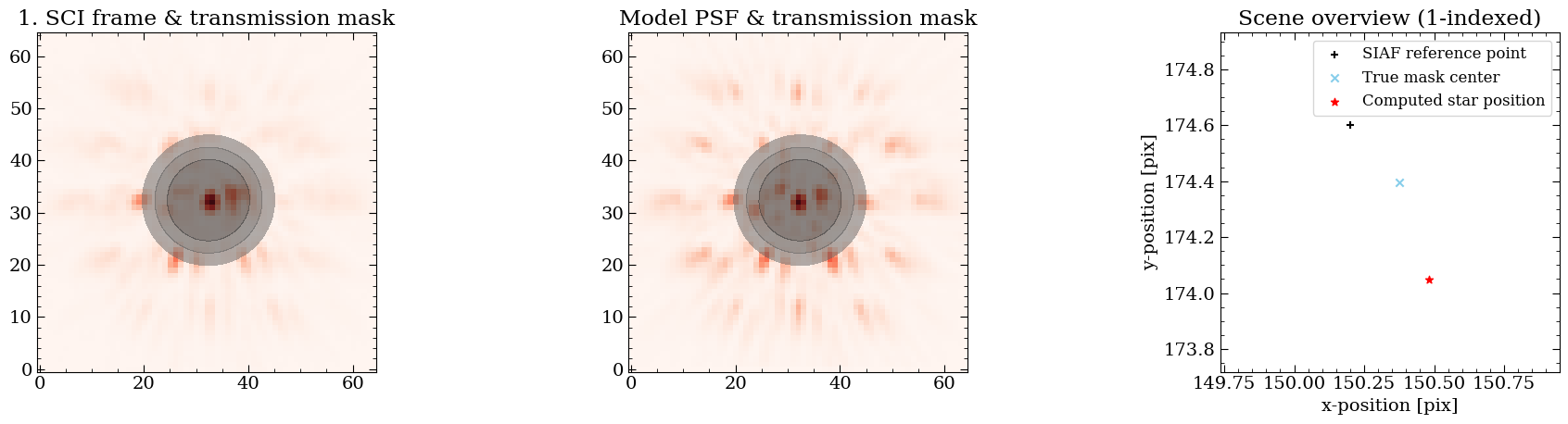
use_ta = False: The output plot features three panels: the first displays the cropped science image with the transmission mask, the second shows the cropped modeled PSF and transmission mask, and the third depicts the computed star position behind the coronagraph, determined by cross-correlating the science (true mask center) and the model PSF (SIAF reference point). Additionally, this step saves output PDFs with plots that detail the centering results.use_ta = True: The plots output above illustrate the TA data, including the measured centroid on board (OSS) and where the WCS expects the star to be. From this data we calculate the offset needed to correct the WCS and determine the true location of the star behind the coronagraph. Additionally, this step saves output PDFs with plots that detail the centering results.
[28]:
!ls data_nircam_hd65426/recenter_shifts/*pdf
data_nircam_hd65426/recenter_shifts/jw01386002001_0310a_00001_nrcalong_calints.pdf
[29]:
# Optional, open one of the plots to view it.
# Note, use of !open assumes you are running this on Mac OS.
!open data_nircam_hd65426/recenter_shifts/*pdf
Calculate Alignment Shifts
Note: If all files were individually recentered (i.e., ``first_sci_only=False`` was used), skip this alignment step, as all frames should be aligned to the center.
When recentering using the default method (first_sci_only=True), a constant offset is applied to each frame to center the star relative to the coronagraph mask. The offset is calculated based on the first SCI frame. As a result, the frames may not be perfectly aligned with one other, meaning the star might not occupy the exact same pixel coordinates in every frame.
To achieve precise alignment across all frames, we use the calculate_alignment function. This function calculates and stores the exact shifts required to align each frame with the first SCI frame (i.e., the second roll and all references are aligned to the first roll).
[30]:
# Align Frames Use image registration to align all frames in a concatenation to the
# first science frame in that concatenation.
if first_sci_only == True:
imageTools.calculate_alignment(method='fourier',
kwargs={},
subdir='alignment_shifts')
[spaceKLIP.imagetools:INFO] --> Concatenation JWST_NIRCAM_NRCALONG_F444W_MASKRND_MASK335R_SUB320A335R
[spaceKLIP.imagetools:INFO] --> Align frames: jw01386002001_0310a_00001_nrcalong_calints.fits
[spaceKLIP.imagetools:INFO] --> Align frames: median required shift = 0.30 mas
[spaceKLIP.imagetools:INFO] --> Align frames: jw01386003001_0310a_00001_nrcalong_calints.fits
[spaceKLIP.imagetools:INFO] --> Align frames: median required shift = 13.63 mas
[spaceKLIP.imagetools:INFO] --> Align frames: jw01386001001_0310e_00001_nrcalong_calints.fits
[spaceKLIP.imagetools:INFO] --> Align frames: median required shift = 17.33 mas
[spaceKLIP.imagetools:INFO] --> Align frames: jw01386001001_0310e_00002_nrcalong_calints.fits
[spaceKLIP.imagetools:INFO] --> Align frames: median required shift = 37.34 mas
[spaceKLIP.imagetools:INFO] --> Align frames: jw01386001001_0310e_00003_nrcalong_calints.fits
[spaceKLIP.imagetools:INFO] --> Align frames: median required shift = 29.52 mas
[spaceKLIP.imagetools:INFO] --> Align frames: jw01386001001_0310e_00004_nrcalong_calints.fits
[spaceKLIP.imagetools:INFO] --> Align frames: median required shift = 15.42 mas
[spaceKLIP.imagetools:INFO] --> Align frames: jw01386001001_0310e_00005_nrcalong_calints.fits
[spaceKLIP.imagetools:INFO] --> Align frames: median required shift = 3.18 mas
[spaceKLIP.imagetools:INFO] --> Align frames: jw01386001001_0310e_00006_nrcalong_calints.fits
[spaceKLIP.imagetools:INFO] --> Align frames: median required shift = 14.07 mas
[spaceKLIP.imagetools:INFO] --> Align frames: jw01386001001_0310e_00007_nrcalong_calints.fits
[spaceKLIP.imagetools:INFO] --> Align frames: median required shift = 28.75 mas
[spaceKLIP.imagetools:INFO] --> Align frames: jw01386001001_0310e_00008_nrcalong_calints.fits
[spaceKLIP.imagetools:INFO] --> Align frames: median required shift = 35.81 mas
[spaceKLIP.imagetools:INFO] --> Align frames: jw01386001001_0310e_00009_nrcalong_calints.fits
[spaceKLIP.imagetools:INFO] --> Align frames: median required shift = 40.28 mas
[spaceKLIP.imagetools:INFO] Plot saved in data_nircam_hd65426/alignment_shifts/JWST_NIRCAM_NRCALONG_F444W_MASKRND_MASK335R_SUB320A335R_align_sci.pdf
[spaceKLIP.imagetools:INFO] Plot saved in data_nircam_hd65426/alignment_shifts/JWST_NIRCAM_NRCALONG_F444W_MASKRND_MASK335R_SUB320A335R_align_ref.pdf
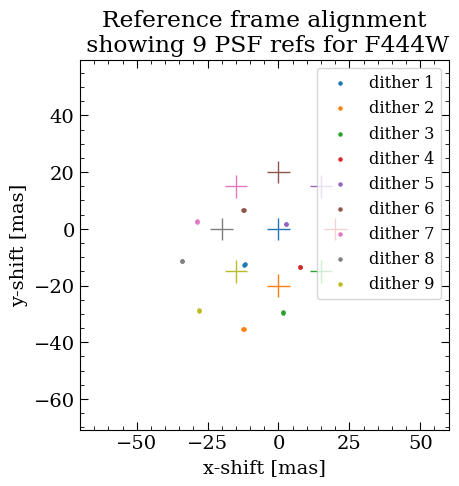
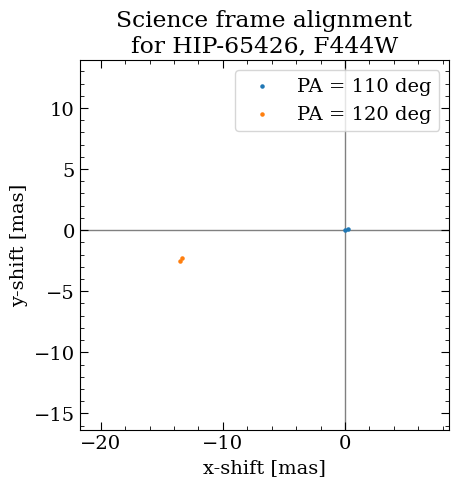
The plots output above illustrate the alignment corrections applied to each frame and also demonstrate the precision of the re-centering process.
Science Frame Alignment Plot: This plot shows the x and y shifts in milliarcseconds (mas) for all science frames, aligned relative to the first science frame, positioned at (0, 0).
Reference Frame Alignment Plot: This plot displays the x and y shifts in milliarcseconds (mas) for all reference frames (PSF references) for the specified filter. The pre-aligned centers are indicated by markers in the legend, with the post-aligned positions marked by +.
Files with multiple integrations are aligned separately, so there may be multiple pre-aligned centers plotted.
[31]:
# This step also outputs plots that show the results of the alignment.
!ls data_nircam_hd65426/alignment_shifts/*pdf
data_nircam_hd65426/alignment_shifts/JWST_NIRCAM_NRCALONG_F444W_MASKRND_MASK335R_SUB320A335R_align_ref.pdf
data_nircam_hd65426/alignment_shifts/JWST_NIRCAM_NRCALONG_F444W_MASKRND_MASK335R_SUB320A335R_align_sci.pdf
[32]:
# Open one to view the alignment of the reference images.
!open data_nircam_hd65426/alignment_shifts/*pdf
Shift Frames
Apply the shifts calculated in calculate_centers and calculate_alignment to the data.
[33]:
imageTools.shift_frames(method='fourier', kwargs={}, subdir='shifted')
[spaceKLIP.imagetools:INFO] --> Concatenation JWST_NIRCAM_NRCALONG_F444W_MASKRND_MASK335R_SUB320A335R
[spaceKLIP.imagetools:INFO] --> Estimated padding for shifting: 15 pixels
[spaceKLIP.imagetools:INFO] --> Shift frames: jw01386002001_0310a_00001_nrcalong_calints.fits
[spaceKLIP.imagetools:INFO] --> Shift frames: jw01386003001_0310a_00001_nrcalong_calints.fits
[spaceKLIP.imagetools:INFO] --> Shift frames: jw01386001001_0310e_00001_nrcalong_calints.fits
[spaceKLIP.imagetools:INFO] --> Shift frames: jw01386001001_0310e_00002_nrcalong_calints.fits
[spaceKLIP.imagetools:INFO] --> Shift frames: jw01386001001_0310e_00003_nrcalong_calints.fits
[spaceKLIP.imagetools:INFO] --> Shift frames: jw01386001001_0310e_00004_nrcalong_calints.fits
[spaceKLIP.imagetools:INFO] --> Shift frames: jw01386001001_0310e_00005_nrcalong_calints.fits
[spaceKLIP.imagetools:INFO] --> Shift frames: jw01386001001_0310e_00006_nrcalong_calints.fits
[spaceKLIP.imagetools:INFO] --> Shift frames: jw01386001001_0310e_00007_nrcalong_calints.fits
[spaceKLIP.imagetools:INFO] --> Shift frames: jw01386001001_0310e_00008_nrcalong_calints.fits
[spaceKLIP.imagetools:INFO] --> Shift frames: jw01386001001_0310e_00009_nrcalong_calints.fits
Now, let’s compare before and after the shift.
[34]:
# Compare how well recentering and alignment did.
spaceKLIP.plotting.display_image_comparisons(
database,
['nanreplaced', 'shifted'], # Subdirectories to look for files in.
restrict_to={'FILTER': filt, # Sort by filter.
'TYPE': ['SCI', 'REF'] # Sort by file type SCI/REF.
},
subtract_first=True, # Subtract the first science frame to check alignment.
interactive=True, # Static or interactive plots?
# Define the min/max/stretch values for consistent image scaling.
# vmin=-0.5, vmax=0.5, stretch=0.05,
save_filename=f'{data_root}/recenter_vs_align_{filt}_comparison.pdf'
)
Note: After recentering and aligning, you may notice image wrapping effects, where parts of the image wrap around from one edge to the opposite edge. This can occur due to the way shifts and transformations are applied. This issue is currently under development to improve the handling of such effects.
Background Subtraction
To help isolate the source signal, we subtract the background from the data with subtract_nircam_coron_background, which uses a multi-component model to fit and subtract the background from NIRCam coronagraphy.
NIRCam-specific Information: The subtract_nircam_coron_background step is only recommended for NIRCam, not MIRI. Also note that this step should only be applied to data that has already been aligned. Otherwsie, it will crash.
[35]:
imageTools.subtract_nircam_coron_background(subdir='bgsub')
[spaceKLIP.imagetools:INFO] --> Concatenation JWST_NIRCAM_NRCALONG_F444W_MASKRND_MASK335R_SUB320A335R
[spaceKLIP.imagetools:INFO] --> NIRCam Background Subtraction: jw01386002001_0310a_00001_nrcalong_calints.fits
[spaceKLIP.imagetools:INFO] --> NIRCam Background Subtraction: fbg:0.243, bg_offset:-0.161, fpsf:195553.993
[spaceKLIP.imagetools:INFO] --> NIRCam Background Subtraction: jw01386003001_0310a_00001_nrcalong_calints.fits
[spaceKLIP.imagetools:INFO] --> NIRCam Background Subtraction: fbg:0.260, bg_offset:-0.170, fpsf:143161.244
[spaceKLIP.imagetools:INFO] --> NIRCam Background Subtraction: jw01386001001_0310e_00001_nrcalong_calints.fits
[spaceKLIP.imagetools:INFO] --> NIRCam Background Subtraction: fbg:0.296, bg_offset:-0.239, fpsf:1467518.992
[spaceKLIP.imagetools:INFO] --> NIRCam Background Subtraction: jw01386001001_0310e_00002_nrcalong_calints.fits
[spaceKLIP.imagetools:INFO] --> NIRCam Background Subtraction: fbg:0.350, bg_offset:-0.248, fpsf:970209.613
[spaceKLIP.imagetools:INFO] --> NIRCam Background Subtraction: jw01386001001_0310e_00003_nrcalong_calints.fits
[spaceKLIP.imagetools:INFO] --> NIRCam Background Subtraction: fbg:0.227, bg_offset:-0.209, fpsf:1495699.714
[spaceKLIP.imagetools:INFO] --> NIRCam Background Subtraction: jw01386001001_0310e_00004_nrcalong_calints.fits
[spaceKLIP.imagetools:INFO] --> NIRCam Background Subtraction: fbg:0.322, bg_offset:-0.280, fpsf:1399236.249
[spaceKLIP.imagetools:INFO] --> NIRCam Background Subtraction: jw01386001001_0310e_00005_nrcalong_calints.fits
[spaceKLIP.imagetools:INFO] --> NIRCam Background Subtraction: fbg:0.318, bg_offset:-0.247, fpsf:814394.808
[spaceKLIP.imagetools:INFO] --> NIRCam Background Subtraction: jw01386001001_0310e_00006_nrcalong_calints.fits
[spaceKLIP.imagetools:INFO] --> NIRCam Background Subtraction: fbg:0.291, bg_offset:-0.217, fpsf:916069.033
[spaceKLIP.imagetools:INFO] --> NIRCam Background Subtraction: jw01386001001_0310e_00007_nrcalong_calints.fits
[spaceKLIP.imagetools:INFO] --> NIRCam Background Subtraction: fbg:0.289, bg_offset:-0.257, fpsf:1401728.121
[spaceKLIP.imagetools:INFO] --> NIRCam Background Subtraction: jw01386001001_0310e_00008_nrcalong_calints.fits
[spaceKLIP.imagetools:INFO] --> NIRCam Background Subtraction: fbg:0.232, bg_offset:-0.212, fpsf:1583632.694
[spaceKLIP.imagetools:INFO] --> NIRCam Background Subtraction: jw01386001001_0310e_00009_nrcalong_calints.fits
[spaceKLIP.imagetools:INFO] --> NIRCam Background Subtraction: fbg:0.265, bg_offset:-0.200, fpsf:1013454.809
[36]:
# Compare before and after background subtraction.
spaceKLIP.plotting.display_image_comparisons(
database,
['shifted', 'bgsub'], # Subdirectories to look for files in.
restrict_to={'FILTER': filt, # Sort by filter.
'TYPE': ['SCI', 'REF'] # Sort by file type SCI/REF.
},
interactive=True, # Static or interactive plots?
# Define the min/max/stretch values for consistent image scaling.
# vmin=-0.5, vmax=0.5, stretch=0.05,
save_filename=f'{data_root}/bgsub_{filt}_comparison.pdf'
)
Masking Neutral Density Squares with NaNs
Occasionally, bad pixel detection and cleaning may not identify all outliersor overflag in NIRCam’s Neutral Density (ND) squares. Since these regions are not used in the analysis, they are masked with NaNs to prevent outliers from affecting PSF alignment and subtraction.
NIRCam-specific Information: The mask_NDsquares step is only recommended for NIRCam, not MIRI.
[37]:
# Mask ND Squares.
imageTools.mask_NDsquares(npix=1, cval=np.nan, minval=0.1,
types=['SCI', 'SCI_BG', 'REF', 'REF_BG'],
subdir='ndmasked')
[spaceKLIP.imagetools:INFO] --> Concatenation JWST_NIRCAM_NRCALONG_F444W_MASKRND_MASK335R_SUB320A335R
[spaceKLIP.imagetools:INFO] --> Frame ND square masking: jw01386002001_0310a_00001_nrcalong_calints.fits
[spaceKLIP.imagetools:INFO] --> Frame ND square masking: jw01386003001_0310a_00001_nrcalong_calints.fits
[spaceKLIP.imagetools:INFO] --> Frame ND square masking: jw01386001001_0310e_00001_nrcalong_calints.fits
[spaceKLIP.imagetools:INFO] --> Frame ND square masking: jw01386001001_0310e_00002_nrcalong_calints.fits
[spaceKLIP.imagetools:INFO] --> Frame ND square masking: jw01386001001_0310e_00003_nrcalong_calints.fits
[spaceKLIP.imagetools:INFO] --> Frame ND square masking: jw01386001001_0310e_00004_nrcalong_calints.fits
[spaceKLIP.imagetools:INFO] --> Frame ND square masking: jw01386001001_0310e_00005_nrcalong_calints.fits
[spaceKLIP.imagetools:INFO] --> Frame ND square masking: jw01386001001_0310e_00006_nrcalong_calints.fits
[spaceKLIP.imagetools:INFO] --> Frame ND square masking: jw01386001001_0310e_00007_nrcalong_calints.fits
[spaceKLIP.imagetools:INFO] --> Frame ND square masking: jw01386001001_0310e_00008_nrcalong_calints.fits
[spaceKLIP.imagetools:INFO] --> Frame ND square masking: jw01386001001_0310e_00009_nrcalong_calints.fits
Pad Empty Space Around Frames
To give space to rotate and align during pyklip. This puts a region of NAN pixels around the outside.
[38]:
# Pad all frames.
imageTools.pad_frames(npix=80,
cval=np.nan,
types=['SCI', 'SCI_BG', 'REF', 'REF_BG'],
subdir='padded')
[spaceKLIP.imagetools:INFO] --> Concatenation JWST_NIRCAM_NRCALONG_F444W_MASKRND_MASK335R_SUB320A335R
[spaceKLIP.imagetools:INFO] --> Frame padding: jw01386002001_0310a_00001_nrcalong_calints.fits
[spaceKLIP.imagetools:INFO] --> Frame padding: old shape = (350, 350), new shape = (510, 510), fill value = nan
[spaceKLIP.imagetools:INFO] --> Frame padding: jw01386003001_0310a_00001_nrcalong_calints.fits
[spaceKLIP.imagetools:INFO] --> Frame padding: old shape = (350, 350), new shape = (510, 510), fill value = nan
[spaceKLIP.imagetools:INFO] --> Frame padding: jw01386001001_0310e_00001_nrcalong_calints.fits
[spaceKLIP.imagetools:INFO] --> Frame padding: old shape = (350, 350), new shape = (510, 510), fill value = nan
[spaceKLIP.imagetools:INFO] --> Frame padding: jw01386001001_0310e_00002_nrcalong_calints.fits
[spaceKLIP.imagetools:INFO] --> Frame padding: old shape = (350, 350), new shape = (510, 510), fill value = nan
[spaceKLIP.imagetools:INFO] --> Frame padding: jw01386001001_0310e_00003_nrcalong_calints.fits
[spaceKLIP.imagetools:INFO] --> Frame padding: old shape = (350, 350), new shape = (510, 510), fill value = nan
[spaceKLIP.imagetools:INFO] --> Frame padding: jw01386001001_0310e_00004_nrcalong_calints.fits
[spaceKLIP.imagetools:INFO] --> Frame padding: old shape = (350, 350), new shape = (510, 510), fill value = nan
[spaceKLIP.imagetools:INFO] --> Frame padding: jw01386001001_0310e_00005_nrcalong_calints.fits
[spaceKLIP.imagetools:INFO] --> Frame padding: old shape = (350, 350), new shape = (510, 510), fill value = nan
[spaceKLIP.imagetools:INFO] --> Frame padding: jw01386001001_0310e_00006_nrcalong_calints.fits
[spaceKLIP.imagetools:INFO] --> Frame padding: old shape = (350, 350), new shape = (510, 510), fill value = nan
[spaceKLIP.imagetools:INFO] --> Frame padding: jw01386001001_0310e_00007_nrcalong_calints.fits
[spaceKLIP.imagetools:INFO] --> Frame padding: old shape = (350, 350), new shape = (510, 510), fill value = nan
[spaceKLIP.imagetools:INFO] --> Frame padding: jw01386001001_0310e_00008_nrcalong_calints.fits
[spaceKLIP.imagetools:INFO] --> Frame padding: old shape = (350, 350), new shape = (510, 510), fill value = nan
[spaceKLIP.imagetools:INFO] --> Frame padding: jw01386001001_0310e_00009_nrcalong_calints.fits
[spaceKLIP.imagetools:INFO] --> Frame padding: old shape = (350, 350), new shape = (510, 510), fill value = nan
Display the Cleaned Datasets
After applying all the previous steps, review the cleaned data. If you notice artifacts near bad pixels, it is likely that some were not identified and have persisted. To address this, you may need to revisit the bad pixel identification process, adjust the parameters, or add a custom bad pixel map.
[39]:
spaceKLIP.plotting.display_coron_dataset(
database,
restrict_to={'FILTER': filt, # Sort by filter.
'TYPE': ['SCI'] # Sort by file type SCI/REF.
},
interactive=True, # Set to False for static plots.
zoom_center=3, # Optional zoom factor; set to None to disable.
bbox_color=None, # Remove background text boxes.
save_filename=f'{data_root}/plots_{filt}_stage2_cleaned.pdf' # Save plots to PDF.
)
Stage 3 Reductions: KLIP
PSF Subtraction: Option Using pyKLIP
Now that we have cleaned up our data to account for alignment and bad pixels, we are ready to perform PSF subtraction. SpaceKLIP supports several algorithms for this step, including the recommended pyKLIP↘️ and the JWST Coron3Pipeline↘️. In this case, we will use pyKLIP for subtraction.
You can customize the PSF subtraction process by adjusting the following settings:
mode: Choose from different image processing techniques, such as ADI, RDI, or a combination of both.
annuli: This parameter determines the number of concentric ring-shaped regions used for PSF subtraction. By specifying different numbers of annuli, you control the radial regions where the subtraction is applied, helping to remove the PSF at various distances from the center of the star. Default is [1].
subsections: This parameter defines the number of smaller regions or segments within each annulus where the PSF subtraction is applied. By breaking down the annuli into subsections, the algorithm can fine-tune the subtraction process. The default value is [1].Number of KL Modes (
numbasis): This parameter specifies how many Principal Component Analysis (PCA) modes are used to build the PSF model for subtraction. PCA modes capture different patterns and features in the data, allowing the model to represent and subtract the PSF more accurately. The default values are [1, 2, 5, 10, 20, 50, 100], which allows us to test different PSF models.
algo: Select the processing algorithm (here, klip).
save_rolls: A roll refers to a set of images taken during a specific pointing direction or orientation of the telescope. Enabling this parameter will save the PSF-subtracted versions of each individual science roll separately, in addition to the roll-combined final product.
These options help tailor the analysis to better suit your specific data and objectives.
[40]:
# Run pyKLIP pipeline. Additional parameters for klip_dataset function can
# be passed using kwargs parameter.
spaceKLIP.pyklippipeline.run_obs(database=database,
kwargs={'mode': ['ADI', 'RDI', 'ADI+RDI'],
'annuli': [1],
'subsections': [1],
'numbasis': [1, 2, 5, 10, 20, 50],
'algo': 'klip',
'save_rolls': True},
subdir='klipsub')
[spaceKLIP.pyklippipeline:INFO] --> Concatenation JWST_NIRCAM_NRCALONG_F444W_MASKRND_MASK335R_SUB320A335R
[spaceKLIP.pyklippipeline:INFO] --> pyKLIP: mode = ADI, annuli = 1, subsections = 1
Begin align and scale images for each wavelength
Wavelength 4.439e-06 with index 0 has finished align and scale. Queuing for KLIP
Total number of tasks for KLIP processing is 1
Closing threadpool
Derotating Images...
Writing Images to directory /Users/kglidic/Documents/science/spaceKLIP/spaceKLIP/docs/source/tutorials/data_nircam_hd65426/klipsub
wavelength collapsing reduced data of shape (b, N, wv, y, x):(6, 4, 1, 510, 510)
[spaceKLIP.pyklippipeline:INFO] --> pyKLIP: mode = RDI, annuli = 1, subsections = 1
Begin align and scale images for each wavelength
Wavelength 4.439e-06 with index 0 has finished align and scale. Queuing for KLIP
Total number of tasks for KLIP processing is 1
Closing threadpool
Derotating Images...
Writing Images to directory /Users/kglidic/Documents/science/spaceKLIP/spaceKLIP/docs/source/tutorials/data_nircam_hd65426/klipsub
wavelength collapsing reduced data of shape (b, N, wv, y, x):(6, 4, 1, 510, 510)
[spaceKLIP.pyklippipeline:INFO] --> pyKLIP: mode = ADI+RDI, annuli = 1, subsections = 1
Begin align and scale images for each wavelength
Wavelength 4.439e-06 with index 0 has finished align and scale. Queuing for KLIP
Total number of tasks for KLIP processing is 1
Closing threadpool
Derotating Images...
Writing Images to directory /Users/kglidic/Documents/science/spaceKLIP/spaceKLIP/docs/source/tutorials/data_nircam_hd65426/klipsub
wavelength collapsing reduced data of shape (b, N, wv, y, x):(6, 4, 1, 510, 510)
[spaceKLIP.database:INFO] --> Identified 1 concatenation(s)
[spaceKLIP.database:INFO] --> Concatenation 1: JWST_NIRCAM_NRCALONG_F444W_MASKRND_MASK335R_SUB320A335R
TYPE EXP_TYPE DATAMODL TELESCOP ... SUBSECTS KLMODES BUNIT BLURFWHM
------ --------- -------- -------- ... -------- -------------- ------ --------
PYKLIP NRC_CORON STAGE3 JWST ... 1 1,2,5,10,20,50 MJy/sr nan
PYKLIP NRC_CORON STAGE3 JWST ... 1 1,2,5,10,20,50 MJy/sr nan
PYKLIP NRC_CORON STAGE3 JWST ... 1 1,2,5,10,20,50 MJy/sr nan
The stage 3 information in the database is added to another table. The stage 2 information remains in the database, which is needed to maintain the information on rolls and references used in the reduction for forward modeling. In fact the stage 3 outputs include a JSON file that includes the table of the stage 2 data, so if you read in the stage 3 outputs it also learns about the stage 2 inputs.
[41]:
database.summarize()
NIRCAM_F444W_MASK335R
STAGE2: 11 files; 2 SCI, 9 REF
STAGE3: 3 files; 3 PYKLIP
Optional: Re-read Stage 3 Outputs into Database
This shows how you can start re-analyses at this point, once you have run the previous steps.
Note, to read in stage 3 data you must set the readlevel parameter to 3. This invokes code for reading the stage-3 formatted data products, and also implicitly reads in the metadata about the stage 2 files used as input to stage 3.
[42]:
database = spaceKLIP.database.create_database(
input_dir=os.path.join(data_root, 'klipsub'),
file_type='*KLmodes-all.fits',
output_dir=data_root,
readlevel=3,
pid=program)
[spaceKLIP.database:INFO] --> Identified 1 concatenation(s)
[spaceKLIP.database:INFO] --> Concatenation 1: JWST_NIRCAM_NRCALONG_F444W_MASKRND_MASK335R_SUB320A335R
TYPE EXP_TYPE DATAMODL TELESCOP ... SUBSECTS KLMODES BUNIT BLURFWHM
------ --------- -------- -------- ... -------- -------------- ------ --------
PYKLIP NRC_CORON STAGE3 JWST ... 1 1,2,5,10,20,50 MJy/sr nan
PYKLIP NRC_CORON STAGE3 JWST ... 1 1,2,5,10,20,50 MJy/sr nan
PYKLIP NRC_CORON STAGE3 JWST ... 1 1,2,5,10,20,50 MJy/sr nan
[43]:
database.summarize()
NIRCAM_F444W_MASK335R
STAGE2: 11 files; 2 SCI, 9 REF
STAGE3: 3 files; 3 PYKLIP
[44]:
spaceKLIP.plotting.display_coron_dataset(
database,
stage3=True,
restrict_to=filt, # Sort by filter.
interactive=True, # Static or interactive plots?
zoom_center=5, # Optional zoom factor; set to None to disable.
bbox_color=None, # Remove background text boxes.
save_filename=f'{data_root}/plots_{filt}_pyklip.pdf' # Save plots to PDF.
)
Hurray! We’ve reached the end of the reduction process for NIRCam coronagraphic data. Now, we can move on to Part 2 of this tutorial to analyze the results. At this stage, the planet should appear to the lower left of the KLIP center (indicated by the orange point), along with other background sources. To get a closer look at the planet, consider increasing the zoom_center factor in the plot function above.